



Photo Etched Filtration Media
Precision Metal Foils for Filament Spinning and Filtration
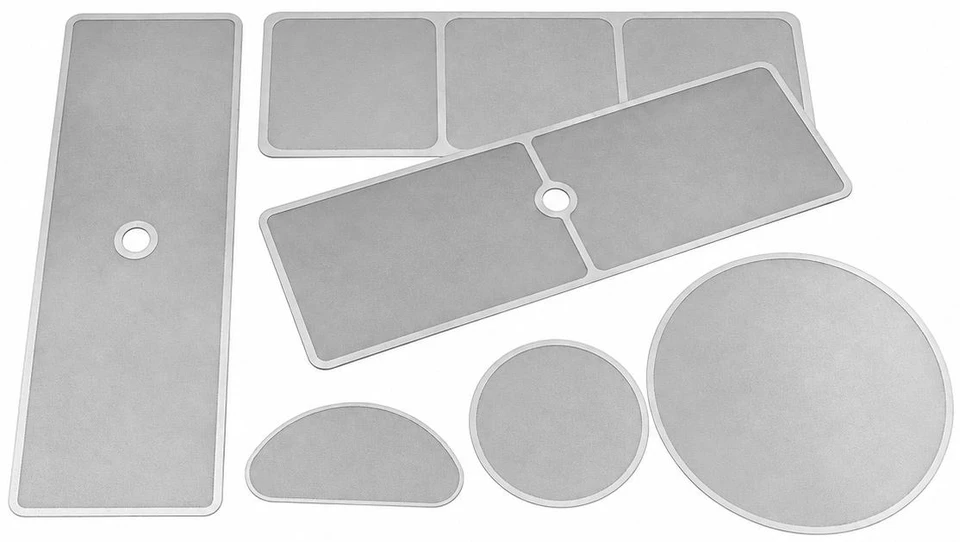
Engineered Aperture Patterns
Round Holes | Elongated Holes | Custom Profiles
Technical Selection
Define the aperture, foil thickness, open area, material and support arrangement together. The finished geometry and inspection requirements form the agreed product specification.
Product Forms and Materials
Precision Openings in Thin Metal Foil
Circular Filter Foil
Representative circular photo etched filter foil with an unperforated outer margin.
Semicircular Filter Foil
Representative semicircular photo etched filter foil with an unperforated outer margin.
Micropore Patterns
Round holes and elongated, waist shaped holes.
External Profiles
Circular, semicircular and rectangular; customer defined profiles.
Materials
Stainless Steel, Copper, Aluminium and other alloy sheets.
Listed Foil Thickness
0.05 / 0.08 / 0.10 / 0.12 / 0.15mm; other sizes by enquiry.
Design Freedom
The photo tool defines the opening pattern and component outline. Unperforated margins, support lands and fixing details can be incorporated into the drawing.
Digital artwork also allows pattern changes without a dedicated punching die.
Two Separate Design Choices
The external contour locates the part in the assembly; the micro hole pattern performs the filtration. Specify both independently, for example, a circular disc with elongated openings.
Manufacturing Principle and Capability
Photochemical Etching
A light sensitive resist protects selected areas of the metal.
After exposure and development, chemical etching removes the exposed metal to form the openings and outer profile.
Prepare the Metal
Select the alloy and thickness, cut the sheet and clean the surface.
Image the Pattern
Apply photoresist, expose the artwork and develop the areas that will be etched.
Etch the Opening
Use a controlled chemical process to remove the unprotected metal.
Finish and Inspect
Strip the remaining resist, clean and dry the part, then inspect it against the drawing.
Published Capability Figures
Confirm the Combination
Minimum aperture, remaining web and tolerance depend on foil thickness, alloy and etch profile. The smallest feature value must not be assumed achievable across the entire thickness range.
A stated hole diameter is a dimensional feature, not a demonstrated particle retention efficiency.
Aperture Geometry and Open Area
Specify More Than Hole Diameter
Round Openings
d = diameter; p = pitch; g = web.
Elongated Slots
L = total length; W = slot width. Schematic plan views; profiles and spacing are illustrative.
Integrate the Foil into the Filter Assembly
Applications and Assembly
Applications include precision screens, filter plates and cartridge media for chemical, petroleum, food and pharmaceutical processing, alongside synthetic filament spinning.
For a spinning application, review the foil within the approved spin pack arrangement, including the upstream media, support components, distribution plate and spinneret. The assembly drawing determines its position and orientation.
Process and Objective
Identify the polymer or fluid grade, contamination concern, current filter reference and the quality improvement sought.
Include throughput, viscosity basis and operating temperature.
Mechanical Duty
State operating pressure, maximum differential pressure, pressure cycling and the supported span.
Include support details, foil flatness, sealing lands and any clamping features.
Aperture and Drawing
Supply the external contour, active area, thickness, aperture geometry, pitch, tolerances and measurement plane.
Identify mounting holes, edge details and the drawing revision.
Material and Cleaning
Confirm the exact alloy grade, cleaning chemistry, temperature and reuse method.
Handling, washing and installation must preserve the thin foil and its openings.
Inspection and Supply
Agree aperture sampling, dimensional inspection, surface cleanliness, material documentation and traceability.
Include trial quantity, expected consumption and delivery requirement.
Trial Acceptance
Compare initial pressure loss, pressure rise during operation, run duration and downstream quality at matched conditions. For spinning, record spinneret blockage and filament breaks against a defined baseline.
Polymer Filtration
Filter media selected for melt conditions and the required particle retention.
Material Selection
Match media construction to temperature, pressure and polymer compatibility.
Technical Support
Discuss filtration area, throughput and pressure drop for the application.